Featured Member: Corpus Navalón-Guzmán

Featured Member shines a spotlight on the diverse research interests of, and the exciting projects undertaken by, those affiliated with the Cultural Memory Studies Initiative. In this eighteenth instalment of the series, we speak to Corpus Navalón-Guzmán ,an FWO Junior Postdoctoral Fellow at Ghent University, whose current research examines the intersections of queer experience and climate trauma in contemporary Anglophone literature. In this interview, she reflects on the intellectual journey that led to her work on queer trauma, discusses her recently published monograph on queer childhood, and introduces her current project on “queer climate trauma.” She also talks about developing and teaching a new course on LGBTQIA+ narratives at Ghent and reflects on possible directions for her research.

So, your research looks at cultural representations of queer trauma. How did you arrive at this topic? What about it interests you?

I think this is one of the questions I’ve gotten the most! I’d like to tell you about a fascinating story, but the truth is that it is simple. Call it curiosity, or just plain interest in all things queer, I’ve always been drawn to the LGBTQIA+ world. Looking back to my university years, I remember always choosing to write essays on films like Milk, Bend it Like Beckham, and even impersonating some works by Oscar Wilde myself in the literature seminars. I was a sucker for reading these stories through canonical concepts both in cultural studies and queer theory, including hegemony, Barthes’ naturalization, and even Butler’s performativity. While everyone was choosing more conventional movies to apply the famous heuristic tools of cultural studies, I felt the need to immerse myself in the lesser known and unvoiced stories that these narratives portrayed.

At the same time, I have always been captivated by the mental processes of human beings, and particularly the way they are spoken about in literature. The movement from stigma to liberalization that mental health illnesses have undergone in the past sixty years has been extremely interesting to see in literary depictions. You can almost chart the changes in how, for instance, a depressive episode is narrated depending on when the book was written. And, widely thinking about the topic of my PhD, I decided that it would be nice to mix the three things that I was mostly interested in, meaning the LGBTQIA+ community, mental health and the literary enactment of these two things. On paper that sounds neat, but for a while it just felt like I was trying to combine three separate obsessions I couldn’t quite put together since I didn’t yet have a conceptual link that could hold the three in the same frame without the work turning too pathological.

But all of this was solved when I stumbled upon Ann Cvetkovich’s monograph, An Archive of Feelings —shoutout here to my PhD supervisor— and the concept she proposes there: queer trauma. She focuses on unearthing lesbian psychic wounds in order to make them central points for discussion around queer and trauma cultures. I was really drawn into her insistence that trauma doesn’t have to be spectacular to matter and that the quiet, ordinary, cumulative kind deserves just as much scholarly attention as the dramatic kind. She’s explicitly working against a clinical model that treats trauma as a diagnosable event, and instead proposes an archive built from cultural texts, affects, and everyday practices. Clinical approaches, and even much of trauma theory’s own vocabulary, Cathy Caruth’s, for instance, weren’t really equipped to look at these sorts of practices. That reframing gave me permission, in a way, to take the smaller, less obviously “newsworthy” queer stories I’d been drawn to seriously, and to treat literature itself as the site where this kind of diffuse trauma gets registered.
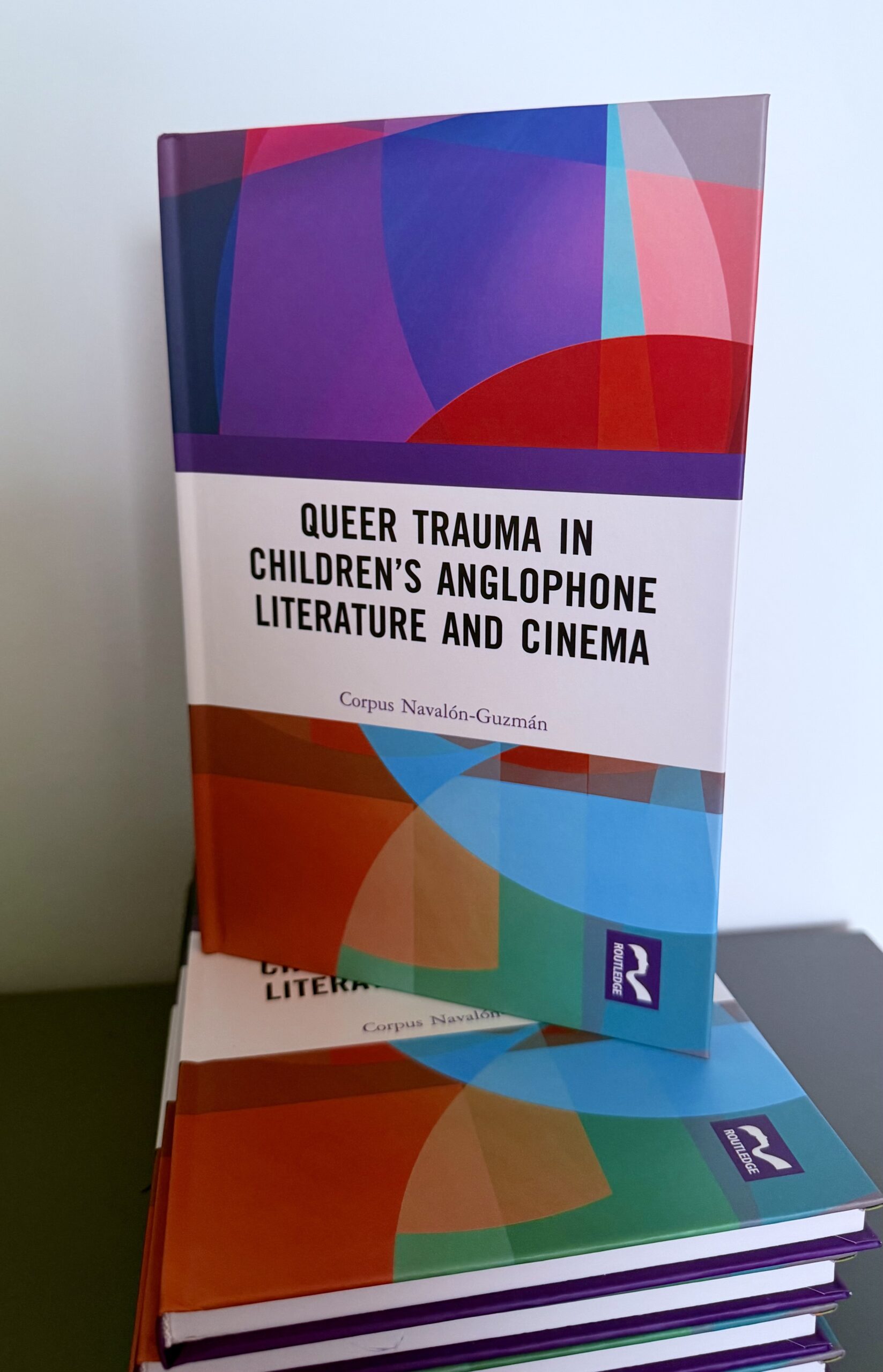
Some of the work from your PhD project has recently been published as a book with Routledge – congratulations! Queer Trauma in Children’s Anglophone Literature and Cinema examines how contemporary English-language novels and films represent trauma in queer childhood and adolescence. The book opens with a fascinating anecdote about the banning of queer books in recent years. Tell us about this. What do you think is the importance of this kind of research in the face of growing homophobia?


The decision to incorporate this discussion into my monograph was not incidental. While I was writing my PhD dissertation, from which this monograph emanates, I found myself extremely affected by an event that was happening in my home country, Spain. Since 2023, several Spanish municipalities governed by Vox (a far-right party, often in coalition with the mainstream conservative PP) have ordered that LGBTQ-themed books are removed from the children’s and youth sections of public libraries. I remember being genuinely baffled because I couldn’t believe why books that were so necessary, that gave visibility to LGBTQIA+ identities in schools, of all places, were being banned. It sounds a bit dramatic maybe, but I felt as if we were back to some earlier, much more repressive moment. And I felt obliged to talk about it in the dissertation, partly because the more I dug into the news around this, the more I realized it wasn’t just a Spain thing, as it was also coming from the States. Moreover, it had a very direct correspondence to my project not only because of the topic I addressed but also because one of the books I was exploring in my dissertation was among those banned, A Year Without a Name (2019). And looking at it from, I suppose, the scholarly side of the window, and really trying to understand how that would affect a queer child’s process of growing up freely, I just felt like I undoubtedly wanted to do something about it.


Interestingly, or frustratingly, when you actually dig into the rhetoric used to justify these bans, it almost never reveals itself as outright homophobia. It is filtered through discourses about protecting childhood innocence, or as a question of “age-appropriateness.” So, this framing became something I wanted to sit with intellectually, not just react to politically. There’s work by people like Kathryn Bond Stockton, Hannah Dyer, and Jack Halberstam that I found myself returning to a lot, which shows how “innocence,” when applied to children, isn’t a neutral category at all. Some children get to be innocent, and others, historically and honestly still now, don’t. So, when queer children’s books get removed from shelves in the name of protecting innocence, what’s actually being protected is a pretty narrow idea of what a child is even allowed to be. It reminds me a little of what Lee Edelman calls the “fantasy of the Child”, this figure of pure reproductive futurity that doesn’t really leave room for queerness at all. And I suppose what I try to do in the book, in my own small way, is push back on that by insisting that queer children existed then and exist now and were and still are living through forms of trauma generated by these kinds of acts. Literature that refuses to represent them isn’t protecting anyone. It’s just leaving the kids who don’t fit that fantasy to deal with it without any language for what they’re going through.
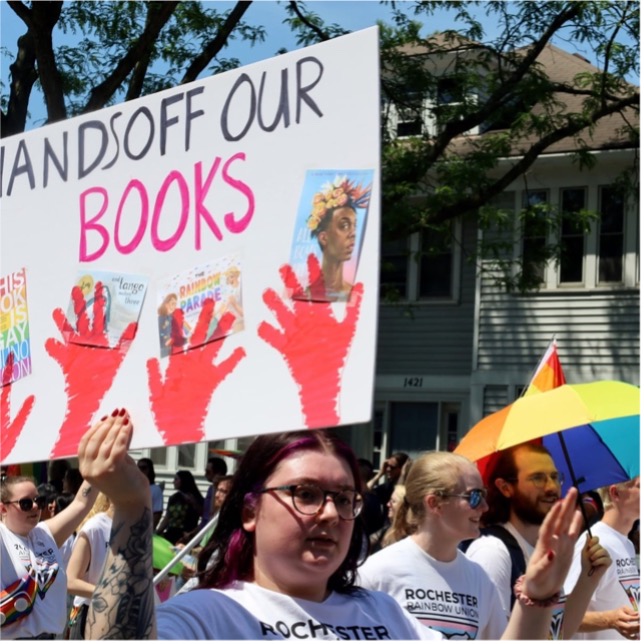
Photo credit: The Guardian
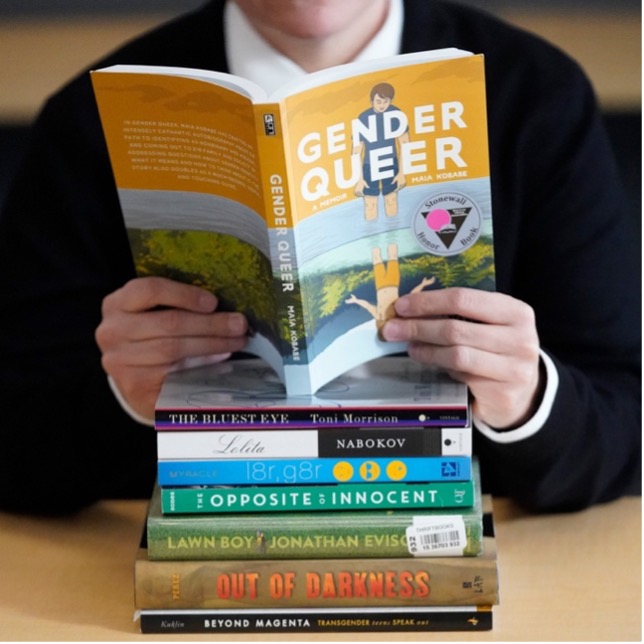
Photo credit: WGME

At UGent you are working on the FWO project ‘Queer climate trauma in contemporary Anglophone literature’ which examines overlooked texts and significant works produced between 2000 and 2020. How does this postdoc relate to your previous work on queer children’s culture? And what are some of the texts you are looking at as part of this new(ish) project? Are there any you think readers of this blogpost should check out? 

Honestly, this project still feels a bit like a leap, even to me, and I mean that in a good way. I started working on it in earnest last year, and I’m actually still excited about it, which I think says something because four years into a PhD you sort of brace yourself to be sick of your own topic by the end. In many ways, this postdoctoral project is a natural continuation of my research into queer trauma and LGBTQIA+ childhoods, since I propose to take the concept to a very different area where, not coincidentally, I am starting to see some commonalities. Across my monograph, and really across the whole four years of the PhD, I was trying to trace the literary and cultural iterations of this form of insidious trauma that unfolds slowly, at the everyday level, and that creates a kind of never-ending wound for the queer community through constant stigmatization, rejection, and violence.

Unknowingly, or maybe not so unknowingly, the current ecological epoch is generating something quite similar, which a number of scholars have taken to calling climate trauma: “an ever-present existential threat” (Woodbury 2019, 5) about an impending environmental collapse that is unfolding slowly. I found a clear structural commonality between climate trauma and queer trauma, in the slowness and insidiousness of both, and I decided to take that as a starting point to explore how this new form of trauma plays out for members of the LGBTQIA+ community. The easy conclusion would be to assume it manifests exactly the way it does for heterosexual, cisgender people, but the truth is that it doesn’t. Emergency reports after catastrophes have documented how trans* individuals were denied shelter during Hurricane Katrina on the grounds of their gender identity. And for those who had already been expelled from home before the disaster even hit, the likelihood of experiencing the physical consequences of a climate catastrophe first-hand was even higher. So, what you get, inevitably, is climate trauma generated, and compounded, by microaggressions that unfold on a daily basis.

I noticed that even though activist groups were already naming this intertwined distress, almost no public media was echoing it, except, interestingly, the literary world. In my project I’ve curated a corpus of around twenty works that explore, from different angles, what I call ‘queer climate trauma’: this is my own attempt to hold both concepts together rather than treat one as a subset of the other. A couple of books I keep coming back to are Sim Kern’s Depart, Depart! (2020) and Rita Indiana’s Tentacle (2015). They sit in quite different genres, the former is more realist, closer to the trauma narrative, whereas the latter more speculative, and deliberately messy about time and causality. But both account for the psychic costs of being rejected on the grounds of queerness at the exact moment that rejection collides with a natural disaster. Formally, they both raise questions about how trauma narratives, historically built around a singular, locatable event, have to accommodate something as diffuse and non-eventful as climate change or queerphobia. That’s partly why I keep returning to Barbara Adam’s notion of environmental time, which resists exactly that kind of single-event temporality. I also keep returning to the sociological idea of ecological myopia, that when a threat is vast enough in scale, the bigger and more urgent it gets, paradoxically the easier to ignore other related issues become.
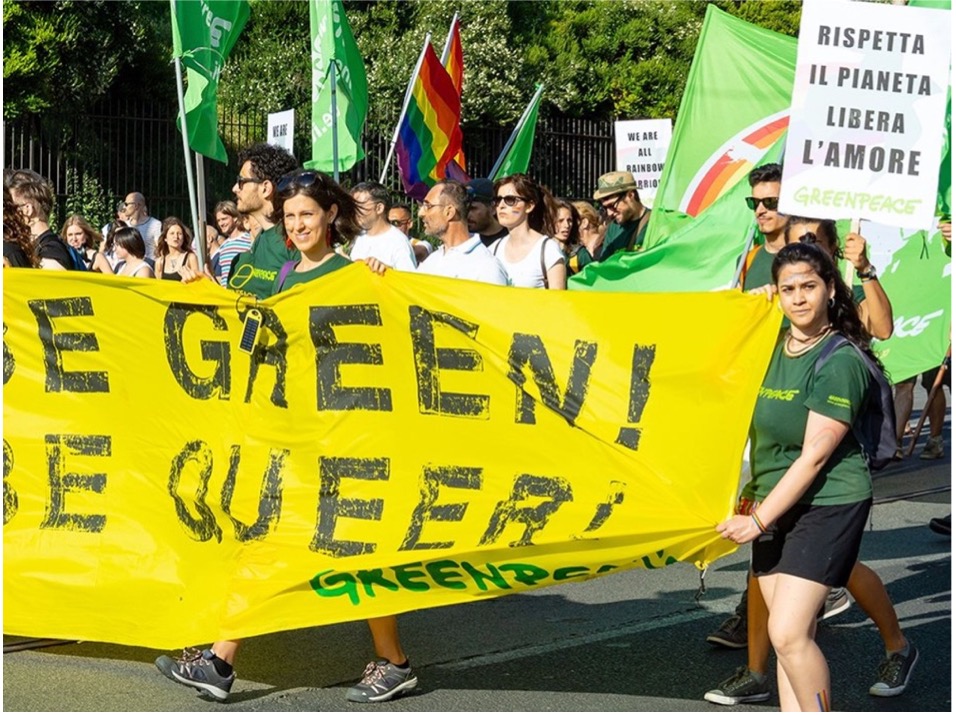
 

Photo credit: Greenpeace

As well as publishing and researching you have been doing a lot of teaching recently, including putting together your own course on queer fiction. How have you found the process of assembling this course and what are your early reflections on teaching it? 

Yes! I’m also extremely grateful that this project has brought me to Ghent, and that I’ve been able to design a course I wish I’d had as a student back in the day. When I was given this opportunity, I knew that I wanted to do something related to queer theory, because while it is a tangential topic in many of the courses proposed here at Ghent University (I even guest-lectured one session on queer trauma at Prof. Craps’ seminar “Words for Wounds: Narrating Trauma”) a full queer lens was lacking. I believe this is not for lack of interest! At the same time, this lacuna is actually happening against a backdrop where humanities degrees and gender-related subjects are actively being cut from curricula by those in power, so carving out space for something explicitly queer feels like a small act of resistance.

The process of putting this course together, and doing something different at the same time, has been a rollercoaster! Sometimes I doubted whether the choices I’d made in terms of primary literature were genuinely interesting to students, and whether they’d offer useful insights to nurture their knowledge on the topic at the same time. I also didn’t want to just do a greatest-hits tour of queer literature, because I wanted each week to be doing something specific theoretically. But after exhaustive feedback from colleagues and friends, I think I found something I could start working with. For instance, I’ll be teaching queer temporalities through The Argonauts (2015), queer posthumanism through Frankissstein (2019), and even queer childhood through the film adaptation of Justin Torres’ novel, We the Animals (2018), and I’ve tried to build the syllabus so that each of these speaks back to the others a little. One of the deliverables of the course is a digital zine based on the students’ critical and creative reflections on some of the theories discussed in class. I liked the idea of a format that’s a bit more playful and DIY than a standard essay, partly because zines have their own history in queer and feminist cultural production. I can’t wait to see what students end up producing!

So far, my experience has been very rewarding. Students have welcomed the course very positively, and the discussions we’re having showcase a genuine interest in the topic, which is encouraging! Something that is surprising me a lot is how willing students have been to bring their own reading angles and experiences into the seminar room. That is something that I don’t think would happen as easily in a more conventional literature course!

Lastly, what is next for you after the FWO postdoc? Are there some other topics that you would love to work on?

A really nice question to end this interview! Though I have to be honest, I still don’t have the ability to see the future, so take everything I say here with a pinch of salt! I hope my next steps keep building on what I’ve already started, of course. I see myself with a permanent position somewhere in Spain (fingers crossed), expanding the course I’ve designed, and maybe teaching something a bit less ambitious but equally productive at the BA level.

As for what comes next research-wise, I genuinely don’t know yet. But something that’s been on my mind lately is Sarah Ensor’s recent book, Queer Lasting: Ecologies of Care for a Dying World (2025) and some of the ideas she puts forth, like that queerness has always held ending and persisting together, and that some of the clearest models we have for living without a guaranteed future came out of the AIDS crisis. I find myself thinking about that alongside queer aging and how little contemporary fiction there is that puts an older queer protagonist at the centre and takes their experience of climate change seriously as its own kind of trauma, on top of everything that generation has already survived. Most cli-fi either skips the elderly altogether, treats them as background or a symbol of a world ending rather than someone who’s already lived through one ending and now has to face another. And climate change is traumatic for older queer people in specific ways. For instance, a lot of them rely on chosen family rather than biological family for care and chosen family networks are exactly the kind of informal support that collapses fastest during a disaster.

I don’t know if that’s where I’ll actually end up. But if it is, I think there’s something genuinely hopeful in it, too, because the same generation carrying all that precarity is also the one that already knows how to build community and care when nothing is guaranteed. That’s not a small thing to have, especially now. So even in the middle of writing about trauma, which is what I’ve done for years at this point, I like the idea of ending up somewhere that’s also about hope and resilience.

 

Exhibition: Sporen van vergeten natuur / Traces of Forgotten Nature

Wat uit onze natuur verdwijnt, vervaagt vaak in ons geheugen. Sporen van vergeten natuur toont hoe archieven vergeten landschappen, planten en dieren opnieuw zichtbaar kunnen maken en ons kunnen helpen  beschermen wat er vandaag nog is.

Locatie: Publieksruimte Amsab-ISG – Bagattenstraat 174 – 9000 Gent

Opening: 23 oktober 2026

Openingstijden: Open op weekdagen van 9 tot 17 uur

Wanneer heb jij voor het laatst een veldleeuwerik horen zingen? Kan je je inbeelden dat er vroeger regelmatig wolven rondliepen in Vlaanderen? Hoe zou het zijn om een steur te vangen in de Schelde? 

Onze natuur verandert voortdurend. Soorten verdwijnen, leefgebieden verschuiven, populaties krimpen of leven weer op.

Het korhoen dat je vanop de affiche van deze expo aankijkt, is daarvan een aangrijpend en actueel voorbeeld. Vandaag leeft de laatste, uiterst kwetsbare populatie in België enkel nog in de Hoge Venen. De recente natuurbrand heeft haar leefgebied zwaar getroffen en haar voortbestaan nog onzekerder gemaakt. Maar wie herinnert zich nog dat deze prachtige vogel ooit op heidevelden en veengebieden in grote delen van België te spotten was?

Ook andere veranderingen voltrekken zich in stilte. Wie vroeger met de auto op zomervakantie naar Frankrijk reed, zag de voorruit na een paar uur vol insecten zitten. Vandaag is dat veel minder vaak het geval. Veel insectengroepen zijn de voorbije decennia immers alarmerend sterk achteruitgegaan, zo blijkt uit Europees onderzoek. Dat heeft gevolgen voor hele ecosystemen.

Wat uit onze omgeving verdwijnt, vervaagt op termijn ook in ons geheugen. We onthouden immers vooral de natuur die we zelf hebben meegemaakt. Daardoor beschouwen we de landschappen, flora en fauna die we vandaag zien al snel als de standaard, ook al zijn ze misschien het resultaat van jarenlange achteruitgang.

Archieven helpen ons die vergeten natuur te reconstrueren. Sporen ervan vinden we in herbaria, reisverhalen, oude foto’s en krantenartikelen. Ook generaties gepassioneerde natuurwaarnemers legden in notitieboekjes, tellingen en tijdschriften nauwgezet vast wat ze om zich heen zagen. Samen geven die bronnen een scherper beeld van hoe onze natuur er vroeger uitzag en wat er sindsdien is veranderd.

In Sporen van vergeten natuur ontdekken we hoe archieven ons verder laten kijken dan ons eigen geheugen. En kennis van wat er was, kan ons helpen beschermen wat er nog is.

Voor meer informatie: https://www.amsab.be/publieksaanbod/publieksevenementen/expo-sporen-van-vergeten-natuur

Exhibition: Tending Loss: Mourning beyond the Human

Guest curator: Stef Craps
Location: RADIUS: Center for Contemporary Art and Ecology, Kalverbos 20, 2611 XW Delft, The Netherlands
Opening: 17 October 2026, 16:00-19:00
Opening hours: Tuesday–Sunday-11:00–17:00

The group exhibition TENDING LOSS: MOURNING BEYOND THE HUMAN, guest curated by Stef Craps, presents work by Allora & Calzadilla with Ted Chiang, Brandon Ballengée, Dominic Boyer, Cymene Howe, and Andri Snær Magnason, Marcus Coates, Marjolijn Dijkman, Raphaël Fischer-Dieskau, Eline Kersten, Katie Paterson, Maarten Vanden Eynde, Cecilia Vicuña, and Sara Vrugt. The exhibition explores the emotional and existential dimensions of ecological disruption. Through installations, sound, film, and performative practices, a space is created in which these often unspoken emotions can be acknowledged and shared. Simultaneously, the exhibition explores new rituals, languages, and collective imaginaries to deal with this loss, not only human, but also multispecies. TENDING LOSS: MOURNING BEYOND THE HUMAN shows that grief need not simply mean paralysis, but can develop into a source of care, solidarity, and resistance, and into a renewed connection with an Earth that changes but never ceases to speak.

For more information, see: https://www.radius-cca.org/en/exhibitions/tending-loss

Theatre: ‘Les mains noires’

Ter gelegenheid van de 70ste verjaardag van de mijnramp van Marcinelle vindt op 16 juni de voorstelling Les mains noires plaats in Theaterzaal Ledeberg in Gent, met steun van o.a. CMSI.

Les mains noires werd gemaakt door Teodoro Katinis samen met Riccardo Bozano en Soumaya Hallak. Regie en tekst (in het Italiaans en het Frans, met Nederlandse ondertitels): Lara Franceschetti.

In de mijn van Bois du Cazier, in Marcinelle, breekt op 8 augustus 1956 een ondergrondse brand de tijd en de levens van honderden families. Terwijl de mijnwerkers afdalen in de buik van de aarde, op zoek naar een betere toekomst, wachten hun echtgenotes en kinderen bovengronds, hopen ze en stellen ze zich een morgen voor van verlossing en waardigheid.

Plaats: Theaterzaal Ledeberg, Ledebergplein 30, 9050 Gent
Datum: dinsdag 16 juni om 20.00 u.
Tickets zijn verkrijgbaar via deze link

Lecture: Lisa Guenther

Date: Thursday 30 April, 14:00-17:00
Location: Library Lab Magnel, Rozier, 9000 Ghent

This “meet the expert” activity consists of a masterclass session with Lisa Guenther (Queen’s University), a leading scholar in critical phenomenology. In this session, she will guide participants through a close reading of two of her key articles, offering insight into how critical phenomenology can illuminate the ways lived experience is shaped by social, political, and material structures.

Critical phenomenology is an innovative and rapidly growing research approach that examines how lived experience is shaped by social, political, and material structures such as race, gender, disability, spatial organisation, and institutional power. Increasingly used across disciplines — including philosophy, sociology, political theory, and health studies– it provides conceptual tools for analysing structural injustice as it manifests in everyday life.

By engaging directly with a key text (or texts) under the guidance of one of the field’s foremost contributors, attendees will gain insight into current debates, emerging research directions, and the societal relevance of phenomenological methods for studying inequality, marginalisation, and systemic violence. The activity aims to foster intellectual exchange across disciplines and institutions and to strengthen doctoral-level research capacity in socially engaged theory. 

Reading materials that we will discuss:

Guenther, L. (2021). Six senses of critique for critical phenomenology. Puncta, 4(2), 5-23.

Guenther, L. (2024).  Collective Memory at Canada’s Prison for Women. Critical Times, 7(2), 260-279.

Registration via: https://event.ugent.be/registration/MasterclassLisaGuenther

Or contact: lei.decappelle@ugent.be / Michiel.deproost@ugent.be

CFP: Memory and Emancipation Conference

First Conference of the Iberian Memory Studies Network

(RIEM, Red Ibérica de Estudios de Memoria)

Barcelona, 16–18 September 2026

Universitat Pompeu Fabra and Centre de Cultura Contemporània de Barcelona–CCCB

Confirmed Keynote Speakers:

Steven Forti (Universitat Autònoma de Barcelona). Historian.

Specialist in the history of fascism, nationalism, and the far right.

Paula Godinho (FCSH-Universidade Nova de Lisboa). Anthropologist.

Author and coordinator of several works on social reproduction, resistance and social movements, political uses of memory, rituals and performance, and the anthropology of the future.

Marta Marín-Dòmine. Writer and independent researcher on issues related to memorial representations. She was Director of the Born Centre de Cultura i Memòria (Barcelona, 2021–23) and of the Center for Memory and Testimony Studies at Wilfrid Laurier University in Waterloo (Canada, 2014–2020).

CFP:

The Iberian* Memory Studies Network (RIEM by its Spanish acronym) invites proposals for its inaugural conference, dedicated to exploring the tensions and dialogues between memory and emancipation as a means to rethink our past, present, and future. In today’s world, the concept of freedom has been appropriated by reactionary forces advocating for a negative and individualistic conception of liberty. In an era marked by multiple crises and democratic regression, ‘emancipation’ has once again become an urgent concept.

But what does it mean to emancipate oneself today? Who is seeking emancipation, and from what? What role does memory —both personal and collective— play in shaping this horizon? And what relationships and tensions arise between memory and the (re)imagination of the past within emancipatory processes? Emancipation implies transforming our relationship with the past and projecting new possibilities for the future. This conference analyses the link between memory and emancipation, conceived as a dynamic process that creates social structures capable of overcoming oppression.

Approaching memory critically not only illuminates historical forms of subordination, resistance, or liberation, but also opens up spaces to imagine alternative ways of living together. At the same time, imagination does not operate in a vacuum: it is nourished by memories, inherited experiences, silences, and fractures. The tensions between established memory frames —which shape and preserve— and imaginations —which displace, reinvent, and prefigure— can lead to new emancipatory processes. Drawing inspiration from recent debates, theoretical reflections, and artistic works, we aim to investigate how Memory Studies can illuminate the complexities and ambiguities of emancipatory experiences (real or metaphorical), challenge established discourses, and open up alternative ways of narrating the past and, consequently, imagining the future.

Contributions may address, but are not limited to, the following questions:

  • How can memories of crises, revolutions, transitions, violence, or resistance expand or reconfigure our notions of emancipation?
  • What dynamics are activated when past emancipatory projects are remembered, re-examined, or reimagined differently?
  • Which theoretical frameworks and new conceptualisations allow us to rethink the relationship between memory and emancipation?
  • To what extent can certain forms of forgetting —strategic, affective, or institutional— hinder or foster emancipation?
  • How do memory and (re)imagination interact in contexts marked by civil rights struggles, social justice, cultural preservation, or ecological survival?
  • Can Memory Studies help us critically evaluate what we understand by freedom and which processes are truly emancipatory?
  • How and in which cases must we emancipate ourselves from memory?
  • Can we conceive of memory as a form of emancipation in itself?
  • What role does the working-through of the past play in an emancipatory process?

We invite researchers and practitioners whose work relates to Memory Studies to contribute to this critical dialogue. The RIEM aims to promote interdisciplinary and methodologically diverse discussions regarding the changing relationship between memory and emancipation in contemporary societies.

We welcome various types of contributions: individual papers (15 minutes), full panels (maximum of 3 speakers), and roundtables. Each session will last 75 minutes to ensure ample time for discussion with the audience. Brief audiovisual screenings, presentations, or artistic interventions that fit within the allotted time will also be considered.

*Please note that the adjective ‘Iberian’ does not refer to questions related to the collective memory of the Peninsula, but rather indicates that the network is primarily composed of scholars working within the region who are interested in memory studies. We also warmly welcome scholars based outside the Iberian Peninsula who have some form of academic connection to the region.

 Proposals: Proposals —comprising an abstract of 250–300 words and a 100-word biographical note— should be submitted via this form by 25 April 2026.

 Languages: The RIEM is strongly committed to both transdisciplinarity and multilingualism. To facilitate academic exchange across the different regions of the Iberian Peninsula, this conference will accept proposals in Basque, Catalan, Galician, Portuguese, and Spanish, as well as English. The conference will include multilingual panels. The organising team is working on strategies to facilitate linguistic exchange and ensure that sessions are as inclusive as possible.

About the RIEM

The Iberian Memory Studies Network (RIEM) is a regional interdisciplinary forum dedicated to the study of memory in its social, cultural, historical, political, and psychological dimensions. The network provides a meeting space for those working in the field of memory in the Iberian Peninsula, aiming to foster the exchange of ideas and the development of collective projects. The adjective ‘Iberian’ does not refer to questions related to the history of the Peninsula, but rather indicates that the network is primarily composed of people working within the region. The RIEM does not intend to replace existing research groups, but rather to become the central forum for researchers from various disciplines with an interest in Memory Studies. As a ‘Regional Group’ of the Memory Studies Association (MSA), we aim to consolidate and expand the status of Memory Studies as a field of knowledge.

***

You can join the RIEM mailing list via this link. For enquiries about RIEM or the conference, please contact: riem.barcelona2026@gmail.com. Please note that all conference proposals must be submitted via the official form.

Organising Committee

Stefano Bellin (Universitat Pompeu Fabra)

Miguel Cardina (Centro de Estudos Sociais – Universidade de Coimbra)

Meritxell Joan Rodríguez (Universitat Pompeu Fabra)

Patricia Georgina Rico León (Universidad Complutense de Madrid)

Johanna Vollmeyer (Universidad Complutense de Madrid)


CFP Mnemonics 2026: Memory and the Future

Goethe University Frankfurt, Germany, 3-5 September 2026

The fourteenth edition of the Mnemonics summer school will be hosted by the Frankfurt Memory Studies Platform (FMSP) and will be held in person at Goethe University Frankfurt, Germany, from Thursday 3 September 2026 to Saturday 5 September 2026.

The annual Mnemonics summer school brings together junior and senior scholars in the interdisciplinary field of memory studies, affording PhD students from around the world the opportunity to receive extensive feedback on their ongoing projects and to catch up with methodological and theoretical debates in memory studies. Each edition features three keynote events and 24 PhD student presentations. Each PhD student will be assigned a senior respondent from a partner institution who will provide an in-depth commentary on their paper. Mnemonics is a unique platform for learning, mentoring, and networking specifically designed to meet the needs and interests of the next generation of memory scholars.


Keynote Speakers


Participating Mnemonics Partners and Friends

  • Tea Sindbæk Andersen (University of Copenhagen)
  • Lucy Bond (University of Westminster)
  • Stef Craps (Ghent University)
  • Rick Crownshaw (Goldsmiths, University of London)
  • Sara Dybris McQuaid (Aarhus University)
  • Astrid Erll (Goethe University Frankfurt)
  • Victoria Fareld (Stockholm University)
  • Brett Ashley Kaplan (University of Illinois Urbana-Champaign)
  • Susanne Knittel (Utrecht University)
  • Silvana Mandolessi (KU Leuven)
  • David Mwambari (KU Leuven)
  • Jessica Ortner Nielsen (University of Southern Denmark)
  • Jessica Rapson (King’s College)
  • Anna Reading (King’s College)
  • Michael Rothberg (UCLA)
  • Hans Ruin (Södertörn University, Stockholm)
  • Hanna Teichler (Goethe University Frankfurt)
  • Alexander Ulrich Thygesen (Aarhus University)
  • Barbara Törnquist-Plewa (Lund University)
  • Johanna Vollmeyer (Complutense University, Madrid)
  • Lena Wetenkamp (KU Leuven)

Theme

The 2026 Mnemonics summer school will address the relationship between memory and the future. Remembering is not just an activity concerned with the past, but just as much—and perhaps even more so—with the present and future. As historian Reinhart Koselleck (1979) has already argued in the 1970s, a society’s “space of experience” shapes its “horizon of expectation.” Recent research in the psychology of memory suggests an integrated “Remembering-Imagining-System” (Conway et al. 2016), where present acts of recall—both individual and collective—shape “future thinking” and vice versa (Szpunar & Szpunar 2016).

Questions of how we imagine the future have gained particular urgency in recent times: Climate change looms large (Craps, Crownshaw & Dolgoy 2025), whilst democracies and transitional societies appear to be backsliding into different forms of authoritarianism (Wertsch 2021; Morina 2026). Many societies grapple with the legacies and impact of colonialism, which often manifest as “continuous pasts” (Adebayo 2023). Wars are raging worldwide.

Another reason to pay closer attention to the nexus between memory and the future is major transformations in the digital realm, especially the uses of social media for memory-making worldwide and the arrival of generative AI (Mandolessi 2023; Merrill et al. 2025). How does the advent of AI challenge the way we will ‘do’ memory in the future? Might AI be the future of collective memory (Gensburger & Clavert 2024)?

How can memory become a resource for the future, even a medium of hope (Rigney 2025)? To what extent can societies “learn from the past” (Gensburger & Lefranc 2020)? And, conversely, where does memory inhibit imagining and acting differently, for example because it remains tied to the modern time regime (Assmann 2020), continues to draw on toxic (colonial and other) archives, implicitly primes us to do “more of the same” (Erll 2022), or has ossified into exclusionary cultures of remembrance (Rothberg 2022)? What types of discourse, media, and art can help envision alternative futures and reflect on the temporalities and mnemonic regimes that we unthinkingly inhabit? By the same token, we also invite participants to reflect on the future of memory studies. What new concepts, methodologies, and practices are required to carry the field into the future?

The 2026 Mnemonics summer school invites PhD students to critically engage with these questions through interdisciplinary dialogue. Participants will reflect on key challenges of addressing the relationship between memory and the future, both through case studies and through theoretical explorations.

Contributions may address a wide range of topics, including, but not limited to:

  • the power of literature, film, and the arts to represent alternative temporalities, thus “breaking up time” (Bevernage & Lorenz 2013) and questioning the “modern time regime” (Assmann 2020)
  • the shifting relations between presentism, past-orientation, and future-orientation (Hartog 2015)
  • the future-thinking and future-making potential of particular media genres (e.g., climate change fiction; Craps, Crownshaw & Dolgoy 2025)
  • environmental memory and the future (Gülüm et al. 2024)
  • indigenous and Global South temporalities (Kennedy & Silverstein 2023)
  • queer temporalities, (post-)memories, and the future (Freeman 2010; Çalışkan 2019)
  • archives and the future (Stoler 2016; Salerno & Rigney 2004)
  • anxiety about the future and pre-TSD (pre-traumatic stress disorder) in life and literature (Batiashvili et al. 2025; Craps 2026)
  • the “hidden power of implicit collective memory” (Erll 2022) and the way it preforms future forms of experiencing, remembering, and acting
  • the problematic phenomenon of “memory before violence” (Buckley-Zistel et al. 2024)
  • how existent forms of commemoration enable or limit future acts of solidarity (e.g., the “historians’ debate 2.0” about memories of the Holocaust, colonialism, and the Israeli-Palestinian conflict; Rothberg 2022)
  • how remembering on social media, the platformization of memory, and AI co-create our futures (Mandolessi 2023; Merrill et a. l 2025; Smit in Erll & Hirst 2026)
  • narratological approaches to memory and future thinking in literature (D’Amato 2025; Milevksi & Wetenkamp 2022; Teichler 2026)
  • interdisciplinary explorations (e.g., where psychological, sociological, and cultural studies approaches to “future thinking and transformative memory” meet; Erll & Hirst 2026)

Format

The summer school will include keynote lectures, general discussions, and professional development sessions. The main emphasis, however, is on the presentation of PhD work in progress in the form of panels of three students who each give a 15-minute talk that is based on their ongoing research while also relevant to the theme of this year’s summer school. In order to foster feedback and discussion, each panel will include an extensive response and a Q&A session.


Practical Information

Local Organizers

Mnemonics 2026 is hosted by the Frankfurt Memory Studies Platform. The organizing team consists of Prof. Dr. Dr. h.c. Astrid Erll, Dr. Hanna Teichler, Konstantina Tsoleridou, and Bhagyashri Vyasaramacharya (all Goethe University Frankfurt).

Where?

The summer school will be held at Goethe University Frankfurt, Campus Westend. Frankfurt am Main International Airport (FRA) is less than an hour away. International trains arrive at Frankfurt am Main Hbf and Frankfurt Süd (a 15-minute subway ride from the university).

When?

The summer school will commence on the morning of Thursday 3 September 2026 and conclude on the afternoon of Saturday 5 September 2026.

Fees

Mnemonics 2026 will not charge any participation fees, but participants will have to arrange and cover their travel to Frankfurt as well as overnight accommodation. Participants can draw from a contingent of twin rooms in a nearby hotel (at 115,50 EUR/person for three nights, breakfast excluded). The organizers will offer a service to bring together participants who wish to share a twin room, and will also cover all lunches and the summer school dinner. 

Applications

Applications are open to all PhD students with an interest in memory studies who are actively enrolled at the time of the summer school. Half of the 24 available spots are reserved for students affiliated with Mnemonics partner institutions. Attendance is in-person only.

To apply, please submit the following via this portal by 15 March 2026:

  • a 300-word abstract for a 15-minute paper (including the title, your name, and your institutional affiliation)
  • a brief description of your PhD research project (one paragraph)
  • a short CV (maximum one page)

Important Dates

  • Application deadline: 15 March 2026
  • Notification of acceptance: 15 April 2026
  • Deadline for paper submission: 24 August 2026

Questions?

Please email MnemonicsFrankfurt@gmail.com 

Relevant Links


References

  • Adebayo, Sakiru. 2023. Continuous Pasts. Frictions of Memory in Postcolonial Africa. Ann Arbor: University of Michigan Press.
  • Assmann, Aleida. 2020 [2013]. Is Time Out of Joint?: On the Rise and Fall of the Modern Time Regime. Ithaca, NY: Cornell UP.
  • Batiashvili, Nutsa, Meymune Nur Topçu and James V. Wertsch. 2025. “Memory and Anxiety: A Sociocultural Approach: Introduction to the Special Collection.” Memory, Mind & Media 4 (2025): e9. https://doi.org/10.1017/mem.2025.10004
  • Bevernage, Berber and Chris Lorenz, eds. 2013. Breaking Up Time: Negotiating the Borders between Present, Past, and Future. Göttingen: Vandenhoek & Ruprecht 2013.
  • Buckley-Zistel, Susanne, Kaya de Wolff, Astrid Erll, Sybille Frank, Nicolai Hannig, Sabine Mannitz Mariel Reiss, Jona Schwerer, Sara-Luise Spittler, and Monika Wingender. 2024. “Memory Before Violence.” TraCe Working Paper5, Frankfurt/M . DOI: 10.48809/PRIFTraCeWP2405
  • Çalışkan, Dilara. 2019. “Queer Postmemory.” European Journal of Women’s Studies 26 (3): 261–73. https://doi.org/10.1177/1350506819860164.
  • Conway, Martin A., Catherine Loveday, and Scott N. Cole. 2016. “The Remembering-Imagining System.” Memory Studies 9 (3): 256–265. https://doi.org/10.1177/1750698016645231
  • Craps, Stef. 2026. “Trauma of Tomorrow: Environmental Breakdown, Affect, and Cultural Narratives,” in Erll & Hirst 2026.
  • Craps, Stef, Rick Crownshaw and Rebecca Dolgoy. 2025. “Introduction – Climate Witnessing: Memory, Mediation and the More-than-Human.” Memory Studies Review, 2(2), 103-125. https://doi.org/10.1163/29498902-20250201
  • D’Amato, Gabriele (2025) “Multiperspective Fictions and the Implicated Narrator.” Ticontre Teoria TestoTraduzione 23: 123-142. (https://teseo.unitn.it/ticontre/article/view/3537/3969)
  • Erll, Astrid (2022) ‘The Hidden Power of Implicit Collective Memory’ Memory, Mind & Media 1.e14: 1–17. DOI: https://doi.org/10.1017/mem.2022.7
  • Erll, Astrid and William Hirst, eds. 2026. Cognition, Culture, and Political Momentum. Breaking down the Silos in Collective Memory Research. New York: Oxford UP 2026. (Esp. the chapters in section 7: “Future Thinking and Transformative Memory”) https://global.oup.com/academic/product/cognition-culture-and-political-momentum-9780197788332?cc=de&lang=en&#
  • Freeman, Elizabeth. 2010. Time Binds: Queer Temporalities, Queer Histories. Duke University Press. https://doi.org/10.2307/j.ctv1198v7z
  • Gensburger, Sarah, and Sandrine Lefranc. 2020. Beyond Memory: Can We Really Learn from the Past? Palgrave.
  • Gensburger, Sarah and Frederic Clavert, eds. 2024. Is Artificial Intelligence the Future of Collective Memory? Special issue of the Memory Studies Review 1 (2). https://doi.org/10.1163/29498902-202400019
  • Gülüm, Erol, Paul Leworthy, Justyna Tabaszewska & Hanna Teichler, eds. 2024. Memory and Environment. Special issue of the Memory Studies Review 1 (1). https://doi.org/10.1163/29498902-20240007
  • Gutman, Yifat, Brown, Adam D., and Amy Sodaro, eds. 2010. Memory and the Future: Transnational Politics, Ethics and Society. Basingstoke: Palgrave Macmillan. https://doi.org/10.1057/9780230292338
  • Hartog, François. 2015. Regimes of Historicity: Presentism and Experiences of Time. Translated by Saskia Brown. New York: Columbia University Press.
  • Kaplan, Brett Ashley, ed. 2023. Critical Memory Studies: New Approaches. London: Bloomsbury. https://doi.org/10.5040/9781350233164
  • Kennedy, Rosanne & Ben Silverstein. 2023. “Beyond Presentism: Memory Studies, Deep History and the Challenges of Transmission.” Memory Studies 16(6), 1609-1627. https://doi.org/10.1177/17506980231203645
  • Koselleck, Reinhart. 2004 [1979]. Futures Past: On the Semantics of Historical Time. Translated by Keith Tribe. Cambridge, MA: MIT Press.
  • Mandolessi, Silvana. 2023. “The Digital Turn in Memory Studies.” Memory Studies 16 (6): 1513-1528. https://doi.org/10.1177/17506980231204201
  • Merrill, Samuel, Mykola Makhortykh, Silvana Mandolessi, Victoria Grace Richardson-Walden, Rik Smit, and Qi Wang. “Handling the Hype: Demystifying Artificial Intelligence for Memory Studies.” Memory, Mind & Media 4 (2025): e18. https://doi.org/10.1017/mem.2025.10018
  • Milesvki, Urinana and Lena Wetenkamp (2022) “Introduction: Relations between Literary Theory and Memory Studies”. In Journal of Literary Theory XVI. 2 (2022): 197-212. https://doi.org/10.1515/jlt-2022-2022
  • Morina, Christina. 2026. Das amerikanische Beben. Erfahrungen und Konsequenzen für die deutsche Demokratie. München: Siedler.
  • Rigney, Ann. 2025. Remembering Hope. The Cultural Afterlife of Protest. New York: Oxford UP. https://fdslive.oup.com/www.oup.com/academic/pdf/openaccess/9780197789711.pdf
  • Rothberg, Michael. 2022. “Lived Multidirectionality: ‘Historikerstreit 2.0’ and the Politics of Holocaust Memory.” Memory Studies 15 (6): 1316-1329. https://doi.org/10.1177/17506980221133511
  • Salerno Daniele and Ann Rigney, eds. 2024. Archiving Activism in the Digital Age. Amsterdam: Institute of Network Cultures. https://networkcultures.org/blog/publication/archiving-activism-in-the-digital-age/
  • Stoler, Ann L. Duress. 2016. Colonial Durabilities in Our Times. Durham/London: Duke UP.
  • Szpunar, Piotr M. and Karl K. Szpunar. 2016. “Collective Future Thought: Concept, Function, and Implications for Collective Memory Studies.” Memory Studies 9 (4): 376–389. https://doi.org/10.1177/1750698015615660
  • Teichler, Hanna. 2026. “Fictions of Transoceanic Memory,” in Erll & Hirst 2026.
  • Wertsch, James V. 2021. How Nations Remember: A Narrative Approach. New York: Oxford UP.

New Special Issue – Climate Witnessing

Climate Witnessing
Special issue of Memory Studies Review 2.2 (2025)
Guest-editors: Stef Craps, Rick Crownshaw, and Rebecca Dolgoy

This new special issue brings together scholars and artists working at the intersection of memory studies, the environmental humanities, and museum and media studies to rethink witnessing in the age of climate breakdown.

Building on and extending trauma and testimony theory, the contributions explore how environmental loss is registered, mediated, and remembered across human and more-than-human scales – from slow violence and deep time to ecological grief, material and aesthetic witnessing, and questions of responsibility and justice.

This special issue grew out of conversations within the Slow Memory COST Action. Almost half of the articles, including the introduction, are Open Access.

Explore the full issue here.


Table of Contents

Introduction—Climate Witnessing: Memory, Mediation and the More-than-Human
Stef Craps, Rick Crownshaw and Rebecca Dolgoy


The Black Gold Tapestry
Sandra Sawatzky


More-than-Human Witnesses and Deep Time

Cast in Stone: Non-human Witnesses for a More-than-Human Age
Clara de Massol de Rebetz

Geologic Testimony: The Fossil as Climate Witness
Mara van Herpen        

Ice Witnesses: Exploring the Natural-Cultural Memory of Climate Change in Susan Schuppli’s Learning from Ice
Simon Probst and Gabriele Dürbeck

The Temporality of Climate Witnessing: Ice, Simulation, Image
Piotr M. Szpunar


Affective Archives and Situated Perspectives

Witnessing Otherwise: Storied Matter, Affect and Climate Change
Katarzyna Więckowska

“Vanishing Points”: Climate Witnessing at the End of the Earth
Lucy Bond and Jessica Rapson


Museums and the Politics of Climate Memory

Museums and the Implicit Anthropocene: Witnessing in the Science Museum’s Energy Hall
Rick Crownshaw

Museum Visitors as Witnesses of Climate Change: Experiencing the Past, Present and Future of the Environmental Crisis in Exhibitions
Sophie Decroupet

Climate Witnessing in Canada’s National Science and Technology Collection
Casey Gray, Rebecca Dolgoy, Peter Hodgins and Barbara Leckie


The Seedling: Transforming Climate through Art and Awi’nakola
Andrew Ambers, Carey Newman and Jeremy Mendes

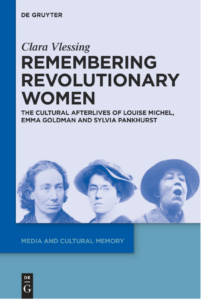
New Book – Remembering Revolutionary Women: The Cultural Afterlives of Louise Michel, Emma Goldman, and Sylvia Pankhurst

Remembering Revolutionary Women: The Cultural Afterlives of Louise Michel, Emma Goldman, and Sylvia Pankhurst
Clara Vlessing
De Gruyter, 2026

Remembering Revolutionary Women considers the afterlives of individual revolutionary women and proposes that to understand how they are remembered requires a focus on the active role of remembering subjects and the groups they form; not only asking how memory persists but also why – what motivates people to make the effort to remember revolutionary women? This question is addressed through a comparative analysis of the cultural remembrance of three committed revolutionaries: Louise Michel (1830–1905), Emma Goldman (1869–1940), and Sylvia Pankhurst (1882–1960). The book takes a plurimedial approach to understanding the cultural afterlives of these three women, drawing from biographical works, artistic installations, performances, portraits and archives. It demonstrates the selective process whereby particular moments or themes in an individual’s life are remembered with greater frequency and affective charge than others.

Remembering Revolutionary Women raises critical questions about the consequences – whether appropriation, sanitisation, individualisation or feminisation – of reclaiming historic women for political ends, bringing original insights to studies of cultural memory, activism, life writing studies and gender.

More information is available here.

Book Launch – Appropriated Memory: The Creation of a German Post-Memorial Literature

Appropriated Memory: The Creation of a German Post-Memorial Literature
Reinhard Zachau
Peter Lang, 2025

Book launch co-organized by CMSI and ILCS, chaired by Mara Josi (UCD)

Date: 13 April 2026
Time: 16:00 (CET) / 15:00 (GMT)
Link: Click here to join the meeting
Meeting ID: 399 021 286 203 8
Access code: T67ad2xa

Th​is​​ b​ook offers a survey of post-World War II German-language post-memorial writing.​ An analysis​ of​ the books by​ Heinrich Böll, Günter Grass, and Wolfgang Koeppen​ e​xposes the difficult path of German writing about the Holocaust. Koeppen’s unauthorized ​​appropriation of Jakob Littner’s survivor memoir serves as the frame for th​is study,​​ ​expos​ing​​ ​the difference​s​ between perpetrator and victim perspectives. The various attempts ​by​ the current generation​ of authors​ to bridge th​is​ ​divide​ ​reflect​ the renewed interest and changed attitude​s​ towards the Holocaust ​that emerged ​in Germany after ​reunification. Included in this volume are W. G. Sebald’s imaginary dialogue between a victim and a perpetrator, Ursula Krechel’s exploration of Jewish life in Shanghai from a Jewish perspective, Iris Hanika’s presentation of the distraught mindset of a member of Germany’s second perpetrator generation, and Kevin Vennemann’s ​narrative about​ a Jewish child in​ the midst of​ a Polish massacre.

More information about the book is available here.

Useful article for preparatory reading: Reinhard Zachau, “German Postmemory Literature of the Holocaust: Koeppen, Wilkomirski, Sebald”

Featured Member: Clara Vlessing

Featured Member shines a spotlight on the diverse research interests of, and the exciting projects undertaken by, those affiliated with the Cultural Memory Studies Initiative. In this eighteenth instalment of the series, we speak to Clara Vlessing, an FWO MSCA Seal of Excellence postdoctoral fellow at Ghent University, whose work explores the intersections of literature, cultural memory, and social movements. In this interview, she traces the paths that led her to memory studies, reflects on her recent book, and introduces her current project on the contentious, complicated legacies of late-twentieth-century feminist figures. Along the way, she considers what CMSI has meant to her intellectually and looks ahead to her next chapter in Ireland.

Your research brings together literature, cultural memory, and social movements. What key questions drive your work, and how did these concerns first take shape?

At its most basic level, my research considers the relationship between the past and the future. I’m interested in how versions of the past press for different futures; how efforts to challenge, reshape, or reconsider what has already happened open up the present to new possibilities. More particularly, I want to understand the ways in which these dynamics play out in the cultural afterlives of politically active individuals, often, but not exclusively, in texts. How are their lives presented in different contexts and to what ends?

That’s the descriptive version of events. Prescriptively, I am also invested in how we can better use radical figures as paradigms for social transformation.

As for the ways in which these concerns first took shape… At the risk of sounding horribly cliché, I think I’ve cared about literature, memory, and movements in some way, shape, or form for as long as I can remember. Not that I was going around as a child chatting about memory studies, but I did love books and history, and was always very drawn to radical or contentious characters. So, these three strands of inquiry have been with me for a long time!

Photo credit: Clara Vlessing

At what point did memory studies become a central framework for you, and what does it allow you to see or do differently? 

What happened is that in 2016 I started a masters in Comparative Literature at Utrecht University, and the course coordinator was Ann Rigney, meaning that memory studies was an essential part of my training as an academic from the beginning. In my first term I took a class where we read Marianne Hirsch, Michael Rothberg, and Stef Craps, as well as some of Ann’s own work, and then a few months later I did a masterclass that she led on memory and protest. That masterclass, as it turned out, was a sort of prototype for the Remembering Activism ERC project (2019-2024) which my PhD was part of.

As I mentioned, I was already interested in the relationship between literature and history, and cultural memory studies is an excellent framework for thinking through that relationship. The work of scholars like Ann and Astrid Erll gave me a vocabulary with which to consider the fluid or constructed nature of the past, the ways in which even the most          official, fixed-seeming narrative about History comes about through iterative storytelling that takes shape across books, images, films, and all sorts of other media. Recognizing that our understanding of the past is always constructed means that you also recognize that is could be constructed differently. I like this idea. I think it is what makes the relationship between memory and social movements particularly dynamic and potentially hopeful.

I often work at the juncture of memory and life writing studies. The latter field is quite inflected by Foucauldian notions of subject formation and psychoanalysis. There’s a lot of cool work on how lives become sites of identification through which writers and readers shape their understandings of the world.

Bringing this into dialogue with cultural memory studies allows for an oscillation that connects scales, hinging between apparently individual and collective notions of the past and situating individual texts within the wider networks that give them meaning. An approach that moves between these scales enables what Jeftic, van de Putte, and Wyss call “an understanding of memory as the result of micro-interactional as well as meso-institutional and macro-cultural processes”. I thought Astrid Rasch’s recent work on Intimate Afterlives of Empire did this really well. It examines autobiographical material for how it reflects and informs the economic, political, social, and ideological forces at play in remembering lives lived during decolonization.

Your recent book Remembering Revolutionary Women explores the cultural afterlives of Louise Michel, Emma Goldman, and Sylvia Pankhurst. Why do these figures still matter today, and what does their continued relevance tell us about how we remember political struggle?

Yes, the electronic version of the book has just been published, and the first chapter is open access. I’m very excited about it!

Michel, Goldman, and Pankhurst were people who gave their all to revolutionary change. They defied so many of the social norms and taboos of their age in ways that were both subtle and extreme: from having a child out of wedlock or being a vegetarian, to attempting to assassinate heads of state, engaging in armed conflict, or hunger striking. They were also all deeply committed to traditions of radical thought that fundamentally guided their political struggles, in Michel’s and Goldman’s cases anarchism and in Pankhurst’s socialism and later left-wing communism.

I think they still matter today because of the all-consuming nature of their political action. These are three revolutionaries who, in different ways and with different outcomes, were pretty uncompromising in their defiance. They really risked everything.

That braveness comes up again and again in the material I draw from in the book, including in interviews that I did with biographers and memory activists. There’s often an element in this of what Enzo Traverso terms “left-wing melancholia”, a yearning for a past before the rise of neoliberalism in which there was perhaps more space for revolutionary politics. People are affectively attached to Michel, Goldman, and Pankhurst; they find them inspiring; they use these figures to imagine a time when more radical change seemed possible.

In my book I theorize “attachment” as an understudied element in memory studies and a vital force in the remembrance of revolutionary women. Of course, the afterlives of political struggle depend on much more than people’s association or identification with historical figures. Cultural memory is also the outcome of what material is available and accessible from these figures’ lives, not to mention the sort of economic and political forces that define the contexts in which they are remembered. But I think that looking at Michel, Goldman, and Pankhurst shows how central claims of likeness or connection are to the remembrance of activism.

Your monograph takes a plurimedial approach, working across texts, images, performances, and archives. What does attention to different media reveal about how memory is created and sustained?

A central idea in cultural memory studies is that memory is circulated through mediation and remediation, that, to quote Ann and Astrid, “particular media offerings become agenda-setters for collective remembrance”. Any one mediation is always produced in dialogue with carriers of memory that may well use a different sort of media. So, for instance, a biography might draw from an archive and then inspire a documentary. Cultural memory is formed in the interaction between these objects – what they repeat, reinforce, or discard – and in their convergence: taken together, they show how the reputation changes over time. From this perspective it doesn’t really make sense to only consider one form of media.

That said, it does make life easier as a researcher to limit yourself. One of the things I struggled with in the book was working out which representations of Michel, Goldman, or Pankhurst to focus on. I ended up going for what I call “longform” mediations in which some representational aspect changes – maybe a new element of one of these figures’ lives comes into view, new sources are found, or they take on a different valence. This means that my research was skewed towards narrative media like books and films.

I would like in the future to find a way of making my research even more “plurimedial”. I’m now beginning to think about a new book project that will come out of my postdoctoral work on the afterlives of feminists from the 1970s. My hope is that this next book will compare an analysis of longform media with research on more ephemeral mediations, social media posts, or protest paraphernalia. That said, I have a tendency to bite off more than I can chew… So we will have to see on that one.


Photo credit: City of London Corporation/Handout

Is there a book, film, or artwork that captures the core concerns of your research, or that has been especially important to you recently? Why?

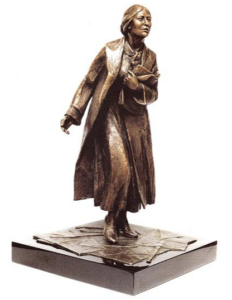
 One of the objects that is at the heart of Remembering Revolutionary Women is a statue of Sylvia Pankhurst, or rather, the campaign to put up a statue of Sylvia Pankhurst. The campaign has been going on since 1998, and the statue itself still hasn’t gone up. It’s still sitting in the foundry where it was cast. At the moment, the organizers are waiting for planning permission, but it was a similar story when I spoke to them five or six years ago.

I keep returning to this statue as a case study for several reasons.

Firstly, because the lengthy campaign and committed memory activists demonstrate the sheer amount of time, effort, and energy that people are prepared to put into remembering Pankhurst. The campaigners are trade unionists and feminist historians who have been going for years, raising money at events up and down the UK. They really care about Pankhurst’s remembrance. The campaign is a very grassroots project with lots of support from many different people, and in that respect it’s not in keeping with the sort of top-down processes that might be expected to lead to a statue’s erection.

This leads me to the second reason I find this case interesting, which is the choice of medium. Pankhurst was a dyed-in-the-wool anti-establishment radical. At points in her life, she completely refused to engage in party politics. Are there tensions here between her beliefs and a statue as a mode of commemoration, particularly when you take into account the initial plan to place the statue outside the Houses of Parliament? I think this case raises important questions about the relationship between a remembered subject and the means of remembrance. Do radical figures require radical methods of commemoration? Does their canonization limit their radical potential?

And lastly, I think this case raises necessary methodological problems. How to study a statue that doesn’t, in any traditional sense, exist? How much weight should we give this campaign in any overview of Pankhurst’s afterlives?

There’s an article by Katrin Antweiler that I’m very drawn to in which she urges more focus on contradiction and fracture in memory studies, writing that “[c]ollective memory will never be fully inclusive nor can it be the arena in which new solidarities emerge because it is epistemologically bound to the ideal of purity”. I think developing ways of studying unfinished projects helps us tackle this ideal of purity that again seems particularly important to engage with for those of us studying activism, which is a pretty messy business. I lead a monthly reading group on memory and activism with Eline Mestdagh and Alexander Ulrich Thygesen, and how to study contradiction comes up again and again.

Alongside your work on revolutionary women, you are currently an FWO MSCA Seal of Excellence fellow at Ghent University. Can you tell us about this project, and how it builds on or diverges from your earlier research? 

My current project “Feminist Provocateurs” is in some respects part two of Remembering Revolutionary Women. Rather than looking at how figures who were active in the early twentieth century have been remembered, it looks at the cultural afterlives of feminist campaigners who have been associated with the women’s liberation movement of the late twentieth century. But in the FWO project I’m much more focused on the recollection of these figures in the present and by those who identify as their political descendants. How are feminists from what has been called “the second wave” remembered today?

I think the feminism of the late twentieth century has a pretty mixed afterlife. On the one hand, there’s a lot of nostalgia for it. In a recent article in the London Review of Books, Jacqueline Rose writes about “a certain form of political faith”, characteristic of the feminism of the 1960s and ’70s, “that the world, at least partly because of the strength of political energy we were bringing to it, would never go so wrong, so terribly and utterly wrong, again”. Mention Audre Lorde to any millennial feminist worth their salt, and they (we) go a bit misty-eyed.

On the other hand, there is an understandable level of wariness about a lot of feminists from this era. When I tell friends that I’m working on Andrea Dworkin, for instance, they usually pull a bit of a face and say something like, “she’s a TERF isn’t she?”  The reality with Dworkin is much more complicated; it depends on who you ask or how you read her writing. But the point here is that my friends’ initial reaction is highly circumspect. There is a long history of a sort of intergenerational struggle in feminist intellectual history – discussed in works like the brilliantly named Not My Mother’s Sister by Astrid Henry – but I think the instant disavowal of older feminists has the potential to be quite counterproductive.

My project considers the losses and gains inherent in this sort of binary recollection. What horizons of possibility does recalling earlier feminists allow for? How are they mobilized for contemporary struggles against intersecting forms of oppression?

You’ve recently been awarded an IRC Postdoctoral Research Fellowship in Ireland – congratulations! How has your time at Ghent University and your involvement with CMSI shaped your research and future collaborations?

Thanks! I’ll be going to University College Dublin in March for a two-year project and to work with Anne Mulhall and several other colleagues across the Centre for Gender, Feminisms & Sexualities. I’m looking forward to this but will miss Ghent, where I’ve met some lovely colleagues.

CMSI is a great forum for wide-ranging discussions about the future of memory studies. We’ve had fascinating conversations during my brief time here about how AI might affect our field or how to engage, as memory scholars, with the genocide in Palestine. And it has been fantastic to work alongside Stef, whose commitment to activism as a part of academic life I find really inspiring.

As for the future, along with Sofía Forchieri, I am now writing an article for a special issue of Storyworlds on memory and narratology, which is edited by UGent’s Gabriele D’Amato and CMSI’s Stefano Bellin. So, in that sense, my association with the university and with the initiative will live on.

Other than that, hopefully I’ll be back in a few years time!

Exhibition: Found

Found is het tweede deel van het drieluik Lost and Found – Caring for What Is (about to disappear). De expo is samengesteld door Tine Hens, auteur van Archief van mogelijk verlies (EPO, 2025) en brengt de verhalen over leeuweriken, gletsjers, vuurvliegjes, olmen uit haar boek samen met zorgvuldig geselecteerde stukken uit de bibliotheekcollectie en met het werk van hedendaagse illustratoren als Jan De Kinder, Carll Cneut en fotograaf Linde Raedschelders.

Het resultaat is een prikkelende dialoog tussen verleden en heden, tussen wetenschap en verbeelding, tussen werkelijkheid en fantasie, tussen ontdekking en verlies.

Collectiestukken in de Boekentoren getuigen van een diverse en overvloedige levende wereld die ooit doodgewoon was, maar nu bijzonder lijkt. Kookboeken, kruidenboeken, atlassen, herbaria, studies van vissen, mossen, zwammen vormen een archief van mogelijk verlies en een dam tegen collectieve amnesie.

De expo omarmt het verdriet om wat al verloren is, nodigt uit tot verwondering, maar verbeeldt ook de oorzaken van al dat verlies en de sporen die we – al dan niet gewenst – achterlaten.

Door de houtsnede van de Melkweg van Frans Masereel uit Die Stadt, treedt de bezoeker een wereld binnen waar Guido Gezelle een ode schreef aan de opgezette dieren in het museum van het Kleinseminarie in Roeselare, waar bomen staan die als klimaatslachtoffers stierven door droogte, bosbrand, verzilting, waar zeemonsters de oceanen bevolken in de atlas van Gerard Mercator, waar Georges Cuvier bij de vondst van de fossiele onderkaak van de Mastodont bedenkt dat soorten kunnen uitsterven.

Bijzondere aandacht gaat naar de tekeningen van Europese planten, vlinders en insecten van Maria Sibylla Merian (1647-1717), die als eerste de intieme verbondenheid tussen bloemen en hun bestuivers beschreef. Als artistiek project en als link tussen levend en papieren erfgoed zal haar plantenwereld na het einde van de expo tot bloei komen op de binnenkoer van de Boekentoren.

Maar de ontdekkingstocht van de natuurlijke wereld, waarvan reisverslagen en prachtig geïllustreerde flora’s getuigen, liep ook samen met kolonisatie, roof en exploitatie. Nog steeds boren we diep in aardlagen om menselijke rijkdom te voeden en te vergaren. Het is een contrast en een spanning waar beeldende kunstenaars Maarten Vanden Eynde en Lola Daels op reflecteren.

En dan is er de vraag naar het erfgoed van later, naar wat blijft en onverwoestbaar lijkt. Tastend, zoekend peutert de expo een luik naar morgen open. Voor het eerst is de Mondkapmeeuw uit de afdeling ‘Dode dieren met een verhaal’ van het Natuurhistorisch Museum Rotterdam in bruikleen te zien. Naast het originele artikel van Leo Baekeland over de ontwikkeling van bakeliet, liggen ‘plastiglomeraten’, nieuwe stenen die ontstaan door de versmelting van plastic en mineralen.

Als voorlopig archief van een mogelijke erfenis.

Meer info en programma: https://boekentoren.gent/nl/artikels/found